
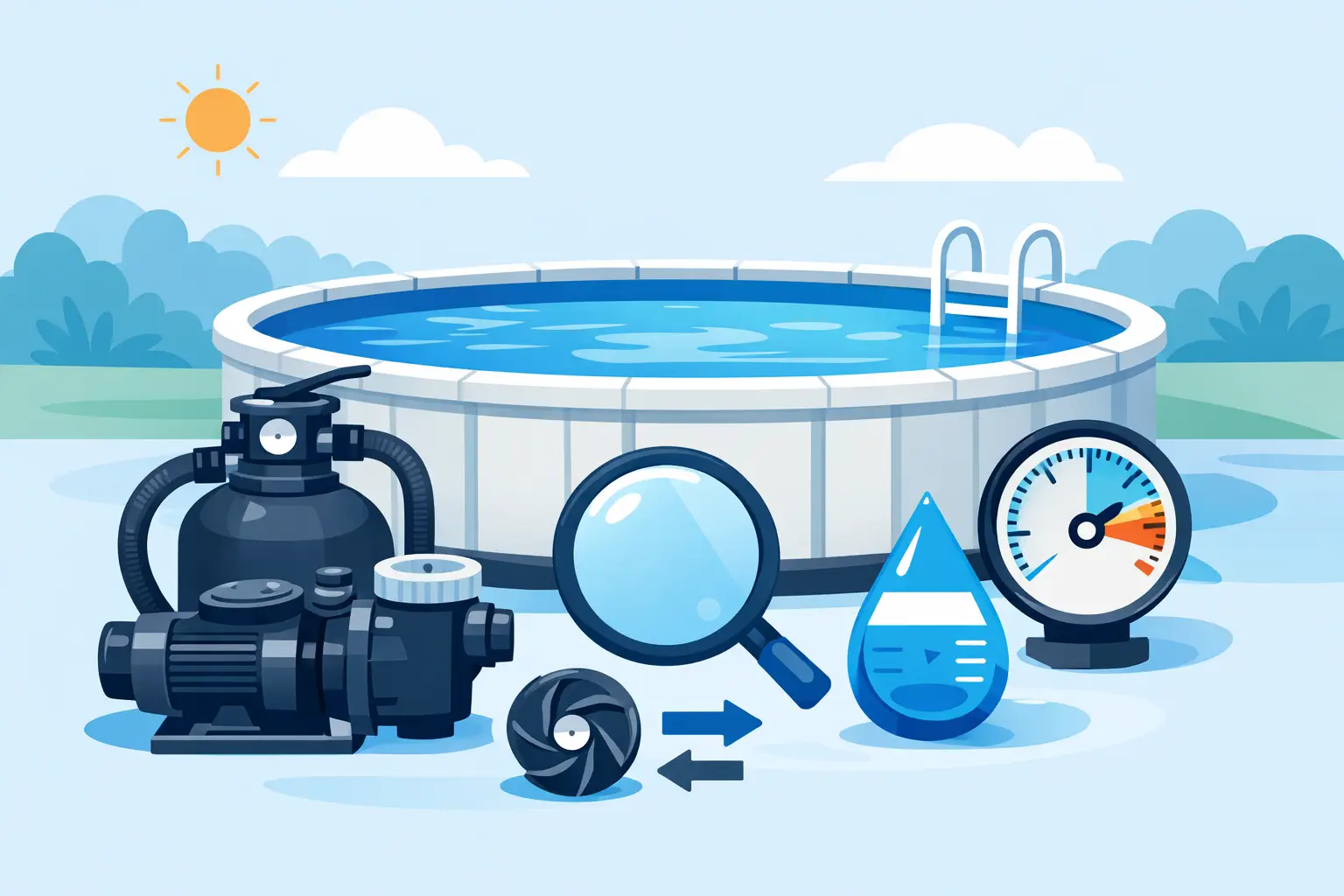
A pump that is too small leaves debris drifting across the pool and makes sanitizer work harder. A pump that is too large can waste electricity, create excess filter pressure, and cost more than your pool needs. Learning how to size pool pump equipment starts with your pool’s water volume, then checks the flow limits of the filter, hoses, and plumbing.
For most above-ground pool owners, the goal is simple: circulate the full pool volume efficiently, keep the water clear, and avoid paying for unnecessary horsepower. Use the steps below before comparing pump and filter specifications.
How to Size Pool Pump by Pool Volume
Start by calculating how many gallons your pool holds. This is the number that drives every other part of pump sizing. Pool labels may list water capacity, but use the actual operating capacity rather than the maximum capacity. Water usually sits several inches below the top rail.
For a round pool, use this formula:
Diameter × diameter × average water depth × 5.9 = gallons
For an oval or rectangular pool, use:
Length × width × average water depth × 7.5 = gallons
Measure depth in feet. If your pool floor slopes, use the average of the shallow and deep ends. For example, a 24-foot round pool with 4 feet of water holds approximately 13,594 gallons:
24 × 24 × 4 × 5.9 = 13,594 gallons
That number does not need to be perfect. A close estimate gives you a practical target for shopping. If your pool manual lists 13,500 gallons at 90% fill, use that figure instead of recalculating.
Choose a Realistic Turnover Time
Turnover time is the number of hours needed to move one full pool volume through the pump and filter. An 8-hour turnover is a dependable starting point for many residential above-ground pools. It balances water quality with reasonable daily energy use.
A shorter turnover time, such as 6 hours, can make sense for a pool with heavy family use, frequent leaves, very warm weather, or recurring water-quality issues. A longer turnover may work for a small, lightly used pool, but it leaves less margin when conditions change.
To find the required flow in gallons per hour, divide your pool volume by the turnover time:
Pool gallons ÷ turnover hours = required GPH
Using the 13,594-gallon example with an 8-hour turnover:
13,594 ÷ 8 = 1,699 GPH
Pump flow is often listed in gallons per minute, so divide GPH by 60:
1,699 ÷ 60 = about 28 GPM
This pool needs roughly 1,700 GPH, or 28 GPM, at its normal operating conditions. That is your working flow target, not necessarily the number printed as a pump’s maximum flow rating.
Do Not Shop by Horsepower Alone
Horsepower is easy to spot on a product listing, but it does not tell the full story. Two pumps with similar horsepower can produce different flow rates because motor design, impeller size, speed settings, and plumbing resistance all affect performance.
Look for a pump’s flow rate at a stated level of resistance, often called total dynamic head or TDH. Water loses flow as it travels through the skimmer, hoses or pipes, filter, heater, salt system, valves, and return fitting. The more resistance in the system, the less water the pump can move.
Above-ground pools with short hose runs and a basic cartridge or sand filter usually have lower resistance than a large in-ground pool with long buried plumbing. Even so, fittings, undersized hoses, clogged filters, and added equipment can reduce real-world flow. A pump advertised at 2,500 GPH may not deliver 2,500 GPH once connected to the system.
Choose a pump that meets your target flow at normal operating conditions. Avoid buying the biggest horsepower rating simply because it sounds more powerful. Oversizing can cause noisy operation, poor filtration, extra strain on components, and higher energy use.
Match the Pump to the Filter’s Flow Rating
The filter is the limit that protects your system. Every pool filter has a maximum flow rate, and your pump should not exceed it. A pump that pushes more water than the filter can handle may cause high pressure, reduced filtration performance, leaks, or damage to filter parts.
Check two specifications on the filter: its maximum flow rate and, when available, its recommended design flow rate. The pump’s expected operating flow should stay at or below the filter’s maximum. If the choices are close, choosing a slightly larger filter is often the safer long-term decision because it provides more filtering surface and usually needs less frequent cleaning.
For example, if your calculated target is 28 GPM, a filter rated for 30 GPM is technically compatible, but there is little room for error. A filter rated for 35 to 40 GPM gives the system more breathing room. This matters when the pump is new, the water is cold, or the plumbing layout has less resistance than expected.
Cartridge filters are straightforward and effective for many above-ground pools, but the cartridge needs regular rinsing and eventual replacement. Sand filters are popular for their simple backwashing routine and durable media bed. The best choice depends on maintenance preference, pool size, and the filter capacity you can match safely with the pump.
Check Hoses, Pipes, and Added Equipment
A properly sized pump can still underperform when the plumbing is restrictive. Many above-ground pools use 1.25-inch or 1.5-inch hoses. Smaller hoses limit flow more quickly, especially with a stronger pump. Do not install a high-flow pump on a system with narrow hoses and expect the advertised output.
Also account for anything water must pass through after leaving the pump. A heater, solar heater, saltwater chlorine generator, vacuum line, decorative fountain, or long run of hose adds resistance. Each item changes the actual flow available at the return fitting.
When comparing equipment, confirm that the pump ports, filter ports, and pool hoses use compatible diameters. Reducer fittings can solve a connection problem, but they may reduce the flow you worked to achieve. If you are upgrading from a small filter-pump combo to a separate pump and filter system, checking port size is just as important as checking GPH.
Single-Speed or Variable-Speed Pool Pump?
For a basic seasonal above-ground pool, a correctly sized single-speed pump can be a practical, value-focused choice. It is simple to install, easy to understand, and works well when run on a timer for the hours needed to achieve turnover.
A variable-speed pump costs more upfront but can reduce operating costs by running at lower speeds for longer periods. Lower-speed circulation is quieter and may improve filtration because water spends more time in the filter. It is especially worth considering for larger pools, long swim seasons, or households that run the pump daily for many hours.
The trade-off is that variable-speed setup takes more attention. You still need enough high-speed flow for vacuuming, backwashing, heaters, or water features. The lowest speed is not always the correct speed. Set the pump so the skimmer pulls consistently and the return has steady flow, then adjust run time based on water clarity and testing results.
A Quick Sizing Check Before You Buy
Before adding a pool pump to your cart, confirm these four details: your pool’s operating gallons, the turnover time you want, the pump’s flow at operating resistance, and the filter’s maximum flow rating. Then verify hose diameter, voltage requirements, and whether the pump includes a timer, strainer basket, fittings, or filter tank.
For the 13,594-gallon pool in this guide, a system designed to provide about 28 GPM during normal operation is a sensible starting point. Pair it with a filter that supports more than that flow, and do not assume a larger horsepower motor will create a better result.
Clear pool water comes from a balanced system, not one oversized component. Measure your pool, compare the specifications carefully, and choose the pump and filter combination that gives your water reliable circulation without paying for capacity you will never use.